
Becoming the Memory Architect: Holding Your Child's Memories Until They Can Hold Them Themselves
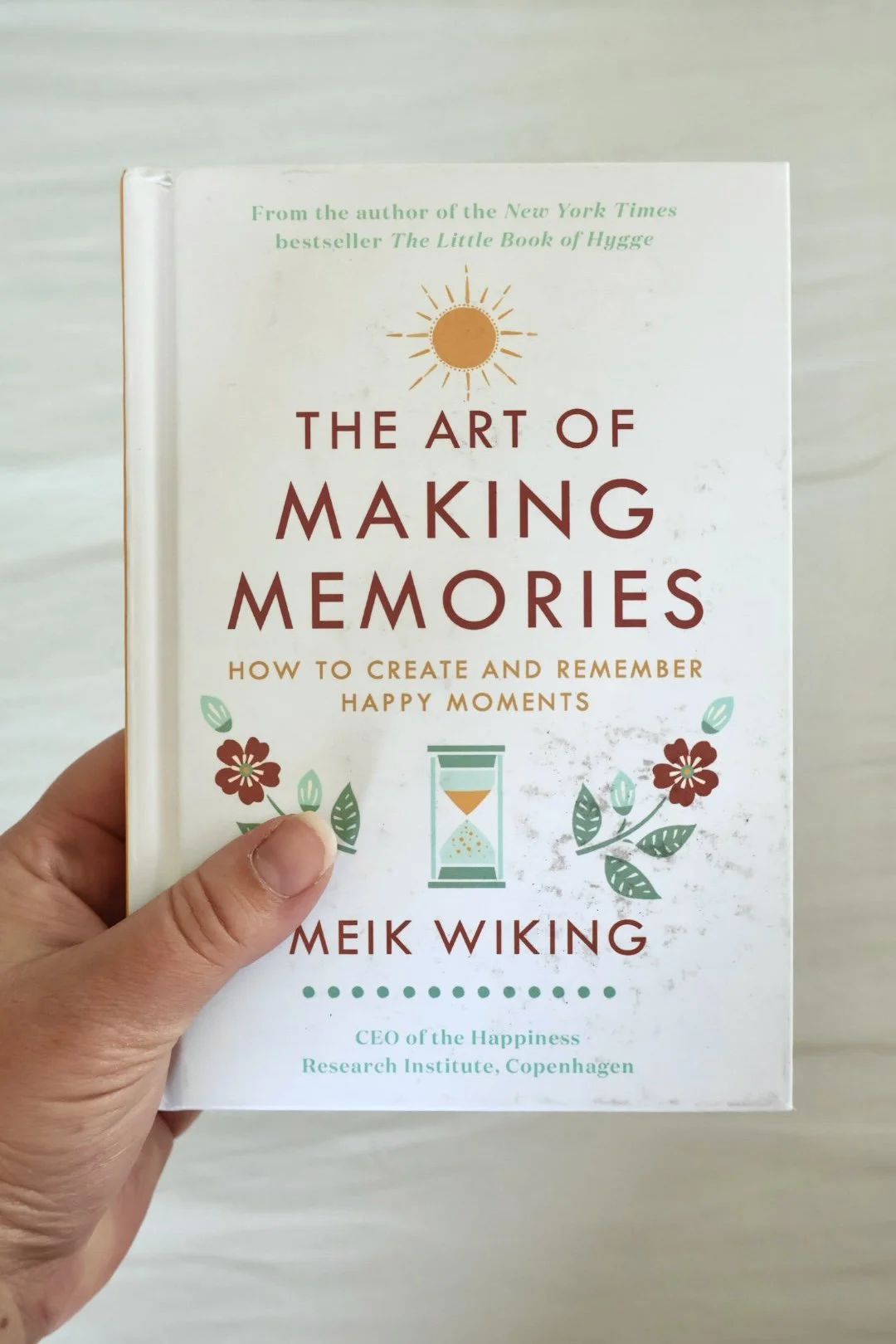
I recently finished The Art of Making Memories by Meik Wiking, CEO of the Happiness Research Institute in Copenhagen. I already wrote a full companion guide on the blog breaking down all 8 of his ingredients for making memories that stick.
This episode is different. It's about the ideas that personally resonated with me — the ones I keep thinking about as a parent of a young child. Because what Wiking writes about isn't just interesting. For those of us in the thick of early parenthood, it's immediately applicable.
Key takeaways
A Kierkegaard quote that reframes why the stories we hold matter so much
The reminiscence bump — and why watching your child's firsts gives you back a small echo of your own
What recent brain science says about whether babies actually form memories
Why "they won't remember it" misses the entire point of the experience
The family story I absorbed as a kid — and the one my mom gave me back years later
How to think about being your family's "memory architect," without it feeling like pressure
Why this idea doesn't have to stop at your own front door
-
Welcome
Hey, welcome to Postcards for Posterity. Make the memories, keep the story. I'm Maddie, and this show is for moms and anyone who takes the pictures and holds the stories in their families, but doesn't want to miss their life while trying to document it.
I recently finished a book called The Art of Making Memories by Meik Wiking. He's the CEO of the Happiness Research Institute in Copenhagen. I wrote a full companion guide on the blog that breaks down all eight of his ingredients for making memories that stick, with the research and how to apply each one. That link is in the show notes.
This episode is about the ideas that personally resonated with me — the ones I keep thinking about, especially as a parent of a young child. Because what Wiking writes about isn't just interesting. For those of us in the thick of parenthood, it's immediately applicable.
Why Memories Matter
There's a quote Wiking includes in the book from the philosopher Søren Kierkegaard: "Life must be lived forwards, but understood backwards."
I love that, because it captures something true about memory that I don't think we talk about enough. We're always moving forward — through the days, the years, the phases — but the meaning of it only becomes clear when we look back.
You won't know which moments mattered most until years from now, or sometimes how it fully shapes you until later. It's like that other quote that I see so often, about how we're living in the good old days but we don't know it yet — which is both humbling and freeing.
It also means the stories we hold, and the ones we tell about our lives, shape everything. Wiking writes that long-term happiness depends in large part on our ability to form a positive narrative of our lives. Our memories aren't just records. They're the story we tell ourselves about who we are.
What we hold onto, and how we hold it, really shapes everything that comes after.
Firsts and the Bump
Wiking also describes something called the reminiscence bump — the tendency for older adults to remember a disproportionate number of memories from roughly ages fifteen to thirty.
The theory is that those years are packed with firsts, and firsts are inherently memorable. Our brains pay closer attention to new things. The extraordinary days are the ones that stick. And I keep thinking about what that means when you're parenting a young child — in part because you're watching someone experience firsts constantly.
First steps, first words, first time tasting something sour and making that face, first time they figure out how to do something they've been working on. You likely don't remember your own first steps. Neither do I. But there's something about watching your child's firsts that gives you back a tiny echo of that feeling — the aliveness of experiencing something for the very first time. You get to be reminded of what that wonder feels like.
And in a way, you get to experience firsts through them — because it's your first time, especially with a first child, experiencing what it feels like to watch someone else experience a first. Maybe that's a little meta. But the research gets interesting too when you look at what's happening in a baby's brain during those early years.
Baby Memory Science
For a long time, we assumed very young children simply couldn't form lasting memories — that their brains weren't developed enough. But more recent research is challenging that. A 2025 study out of Yale used fMRI scans to actually watch babies as young as twelve months old form memories in real time.
The hippocampus — the brain region critical for memory — was active and encoding experiences. The reason we can't recall our earliest years isn't necessarily that the memories weren't formed. It may be that they become inaccessible over time. They might actually be in there somewhere.
And we know that from birth, babies are learning who they are by how they are treated. The first three years are considered a critical period in brain development. The biggest change in brain weight across an entire human lifetime happens in the first year of life.
What Wiking connects to all of this is language and story. Our memories start staying with us — consciously, retrievably — around the time we begin to be able to tell stories about our lives, around three and a half. Which means the experiences before that aren't necessarily gone. They're just held differently.
And I love this quote. He writes: "Your children may forget their own earliest happy memories, so even though it is their happy memory, maybe you can hold onto it for a while and give it back to them when they're old enough to carry it forward."
You are holding their memories until they can carry them themselves.
Be the Memory Architect
That's what memory-keeping means in the early years. And this is where Wiking's idea of the memory architect lands hardest for me. Not keeper. Not documenter. Architect. Someone who doesn't just record what exists, but makes intentional choices about what to preserve and how to frame it.
Because the stories we tell about our children — and to our children — especially in these early years, don't just describe them. In some ways, they become them. The narrative we build around who they are, what they're like, what they've done, gets woven into their identity and reinforced through repetition. It lands somewhere, even when they're too young to push back on it.
The Tantrum Kid Story
I know this personally. I had really big emotions as a kid. Like — really big. As the story goes, I had my first temper tantrum at Easter when I was around three. My temper tantrums lasted for a few years. Out of any story I've heard about myself as a kid, the temper tantrums are the ones I've internalized into my identity the most, because I've heard them so many times, from so many different family members.
There are a couple bright spots in these narratives that I've focused on. One — my mom told me she'd once been told that smart kids often have tantrums. I'm not sure if that's actually true, but the fact that someone framed it that way for her meant something. And two — there was a time we were at the airport flying from LA to Arizona, and I wanted to get on the plane so badly that I kicked and screamed until we boarded. Then the second we were on, I kicked and screamed to get off.
As a parent now, I understand exactly what that breaking point feels like. By the time we landed, my mom was completely done. When we got to my grandparents' house, she handed me to my grandfather and walked away to cool down.
When she came back, I was asleep in his arms. And he said something like — "never treat a little girl that way."
I didn't know my grandfather very well. But that story makes me feel really loved by him.
And I think telling me about my "awful" tantrums might have been my family's way of coping with their own exhaustion and embarrassment in those moments. One thing they'd sometimes tack on was something like, "one day this will come back to you." Families do this — they latch onto certain stories, and it becomes the thing for that person. The trope. The bit that comes up at Thanksgiving to humble you a little. They weren't trying to hurt me with it. It just became easy shorthand for what I was like at that time.
But over years of that shorthand, I absorbed it. It became a big part of my identity in those early years. I was the tantrum kid. The difficult one. Big emotions. And I internalized it more than anyone realized or intended.
Rewrite the Narrative
A few years ago — actually around the time my daughter was born — I asked my mom what I was like as a toddler, beyond the tantrums. And she said: "Curious. Kind. Funny. Smart."
I don't remember hearing that very often growing up, about those specific years. That doesn't mean I didn't feel some of that from them even then — but it was really something to sit with. It actually made me tear up a little when she said it. And it reminded me of something I want to hold onto as a parent: kids are dynamic, and people are dynamic. One story, even a true one, is never the whole picture.
Now I understand more about why those big emotions happened — there's more research and understanding around this than there used to be. I had feelings I didn't know how to handle, and the adults around me didn't always know how to help me through them. That's actually pretty common in early childhood. And my parents did their best with what they knew. I've rewritten and understood that narrative differently now.
So part of this is — your child doesn't have to accept the narrative you create. I hope you don't feel overwhelmed by being the memory architect. They can, and will, eventually write their own story, like I did. But the stories told early do have weight. They land somewhere. It's worth being thoughtful about which ones you keep repeating, and trying to choose and tell stories that paint a dynamic picture — because you are the architect.
It Still Counts Even If They Don't Remember
I want to talk about something I hear a lot, mostly through social media — but maybe you've heard it too, or thought it yourself.
"Why are you taking them to Disneyland? They're two. They won't remember it." "Why spend money on a trip to Europe with a toddler? What's the point?" Or any experience that might feel like a stretch.
I understand the logic. If the goal is to create a memory the child will consciously carry, then yes — a two-year-old probably won't remember the castle. They probably won't remember the flight, the hotel, most of the specific moments. And honestly, for us, traveling has also just been a learning experience — there are things I genuinely hope my daughter doesn't remember from when we've been completely exhausted.
But I want to push back on this, because I think it misunderstands what the experience is actually for.
First — you will remember it. Your partner will remember it. The experience creates memories for everyone in the family, not just the child. The look on her face when she saw the parade. The way she fell asleep in the stroller. The chaos and the joy of navigating something big together. Those are yours to keep.
Second — the research suggests early experiences may shape more than we know, even when they can't be consciously recalled. The emotional environment, the sense of being somewhere new and exciting, the physical sensations of a place — these get encoded at a level that may influence who a child becomes, even without a retrievable memory attached.
And third — my daughter genuinely loves hearing stories about when she was a baby. She can't remember most of it. But she lights up when I tell her about things we did, places we went, moments that were funny or sweet or hard. The story matters to her even without the memory, because the story is part of who she is.
So yes — maybe they won't remember the trip. But you will. And someday, the story of it will be something you can give back to them.
Creating memories — wherever and whatever they may be — and the stories you'll look back on, is what can positively shape the identity of your children, your family, and even yourself.
And if you haven't been told this lately — you are a great parent. If you're listening to this and you've made it this far, you care.
Beyond Your Family
I want to close with something that took this whole idea somewhere unexpected for me. I just finished a novel called Theo of Golden by Allen Levi. It follows a man who is genuinely present — he pays attention, he notices people, he shows up, he observes. And the story is really about how the attention and kindness of one person ripples outward and affects an entire community in ways he never fully sees.
I keep thinking about how that connects to everything Wiking writes about memory. Because being a memory architect doesn't have to stop at your front door. When you ask the grandparent the question they've been waiting to be asked. When you take the photo of someone else's kid having a great moment and send it to their parent. When you show up because you remembered someone was going through something hard. These are small acts of observation and memory-making that ripple outward in ways you'll never fully track.
One person paying attention. One person noticing. That's enough to change the shape of a community's story.
Closing
The blog post companion to this episode has the full breakdown of all eight of Wiking's ingredients for happy memories — the research and how to apply each one practically. That link is in the show notes. It's worth bookmarking.
And The Art of Making Memories itself is absolutely worth reading. I'll link it in the show notes too.
Until next time — make the memories, keep the story. Letters from today, for the days ahead. Postcards for Posterity is connected to my Love, Maddily blog, and that's where I share additional resources, links, and freebies — ways for you to stay more connected to the memories and people in your life.

My mom, Donna, on scrapbooking, memory-keeping, and what she's learned helping clean out the homes of people who've passed. Episode 10 of Postcards for Posterity.