
8 Ways to Make Memories That Actually Stick (Based on the Science of Happiness)
Here's what a happiness researcher wants you to know about why some memories last — and how to make more of them.
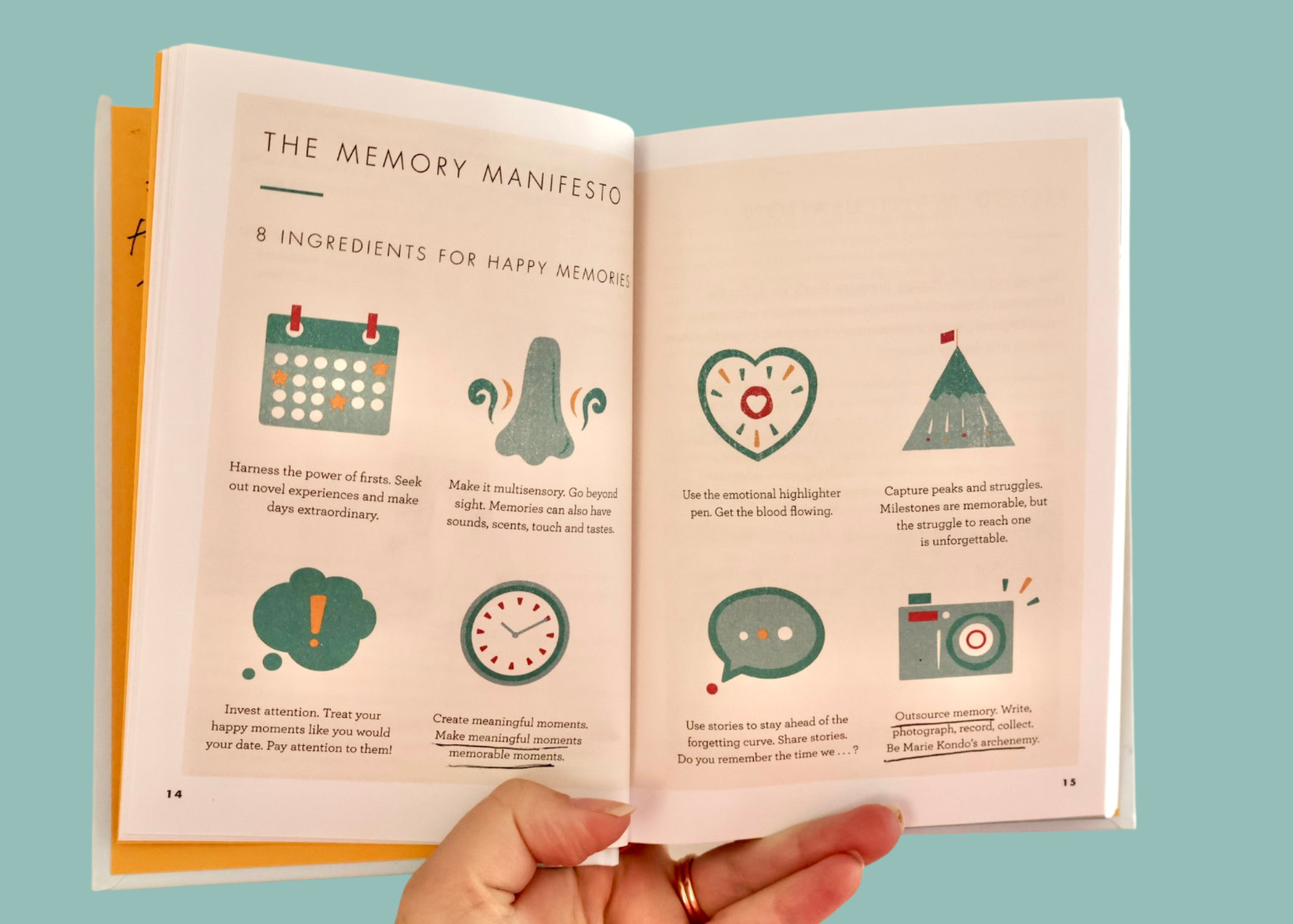
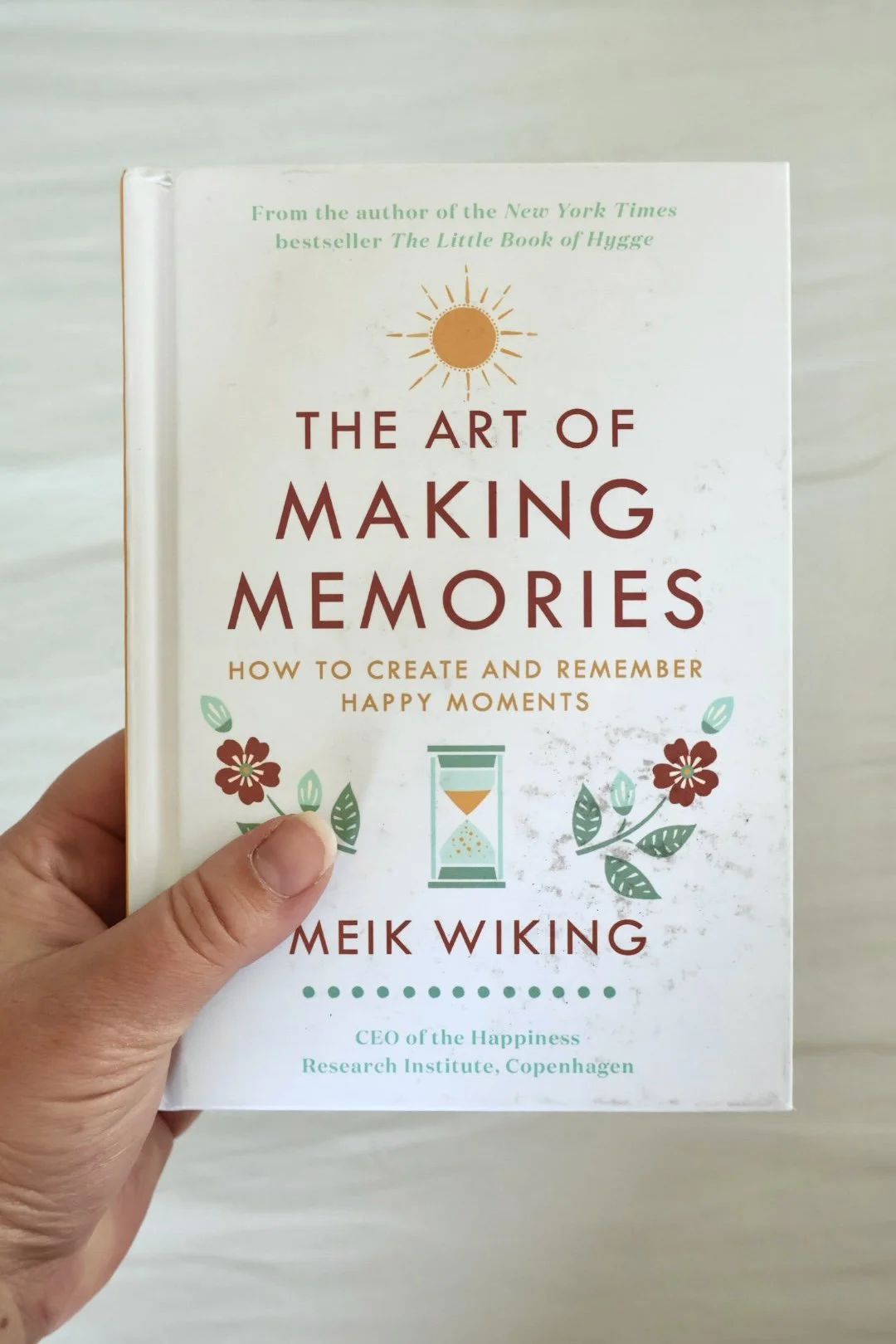
I just finished reading The Art of Making Memories by Meik Wiking — the CEO of the Happiness Research Institute in Copenhagen and one of the world's leading researchers on happiness.
This book made me rethink some things.
Not about whether memories matter. I already believed that. But about how we make them, what actually makes them stick, and why most of what we're currently doing — taking thousands of photos and storing them somewhere we'll never look — might be working against us.
First, the reframe
Before we get into the “8 ingredients,” I want to start with the line that made me know this book is what I’ve been looking for when it comes to understanding memories and how to keep them.
Wiking writes: "Our lives are not the days that have passed, but the days we will remember forever."
I had to read that a few times to process it.
So often, I get caught up in the day to day life of to-do lists and what I need to do to “adult” in a given day. But when I read this, it felt like a little freeing to not get caught up in “the days I might not get back” doing house projects, but the days we actually experience — the one that shapes our identity, the one we look back on, the one that makes us who we are. It's the days we remember.
He also writes that long-term happiness depends in large part on our ability to form a positive narrative of our lives. Our memories aren't just records. They're the story we tell ourselves about who we are.
Which means: how we capture, keep, and return to our memories matters more than most of us realize.
You are the memory architect of your family.
Wiking uses the term memory architect — and I love it more than any other phrase in the book.
Not memory keeper. Not documenter. Architect.
An architect doesn't just record what exists. They design. They make intentional choices. They build something that lasts.
If you're the person in your family who takes the pictures, saves the stories, makes the photo books, asks the grandparents the questions — you are actively shaping your family's identity. What gets remembered. What gets passed down. What your kids will understand about who they are and where they came from.
That is a meaningful responsibility. And it's worth doing with intention.
The 8 ingredients
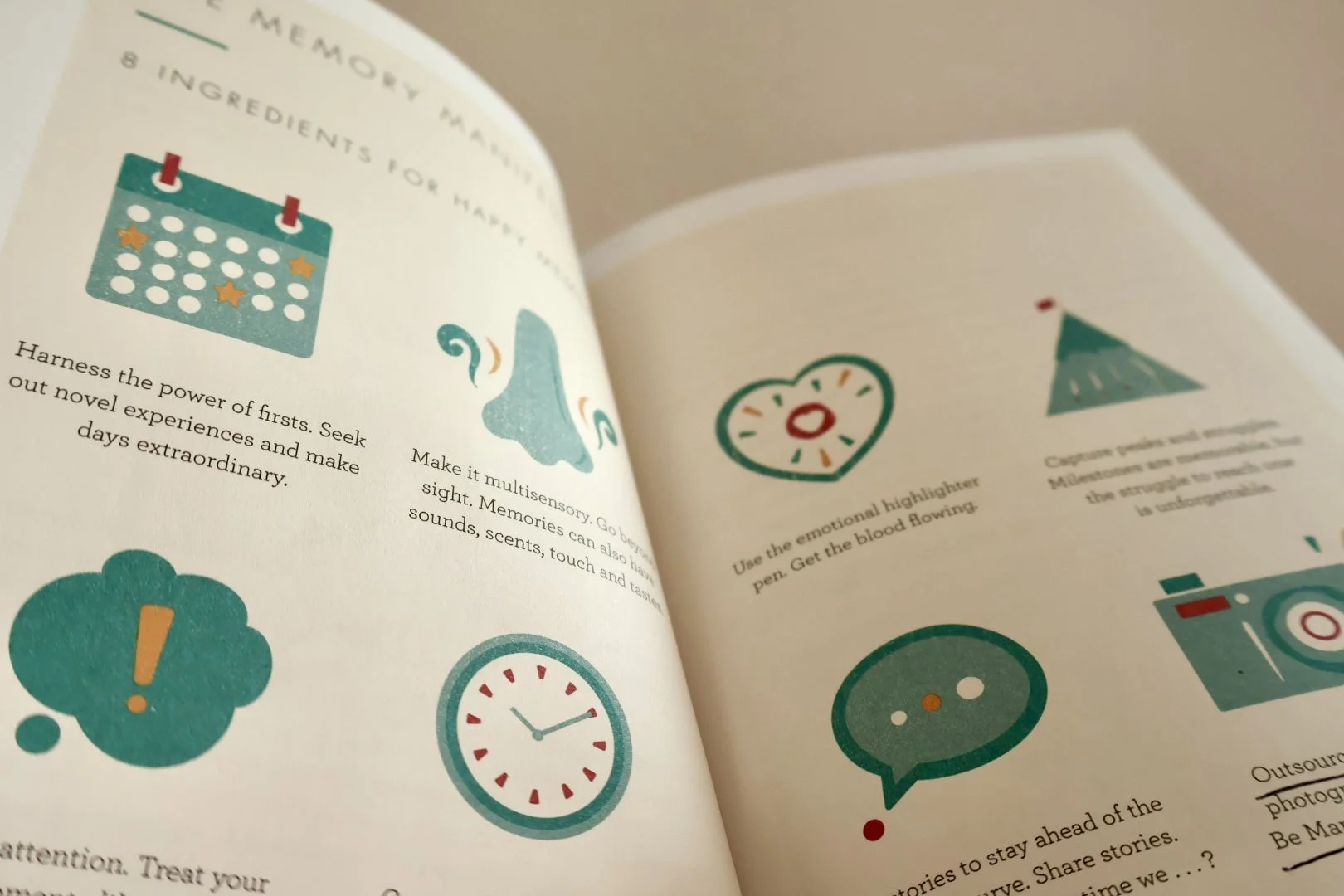
Here are the 8 ingredients Wiking identifies for making memories that stick — plus how to actually apply each one.
1. Harness the Power of Firsts
What the research says:
Novel experiences are significantly more memorable than routine ones. Wiking cites research showing that 73% of vivid memories are either first-time experiences or unique events. Our brains are wired to pay more attention to new things — which means ordinary days, by definition, blur together.
He calls this the reminiscence bump — the tendency for older people to remember disproportionately more memories from ages 15 to 30, when life was full of firsts: first job, first apartment, first love, first real adventure.
How to apply it:
Once a year, go somewhere you've never been — even locally. A new neighborhood, a new trail, a new restaurant that feels out of your comfort zone.
With kids, prioritize new experiences over repeating familiar ones. The first time they see the ocean. The first time they try a food they've never had. These are the memories that last.
Don't wait for big trips. A first can be small. The first time you make a recipe together. The first time they ride without training wheels.
2. Make It Multisensory
What the research says:
We tend to think of memory-keeping as visual — photos, videos, images. But our brains encode memories through all five senses. Smell, in particular, is one of the most powerful memory triggers because it's processed by the same part of the brain that handles emotion and memory.
Wiking shares the story of a woman who vividly remembered her mother roasting poblano peppers — not just the image of it, but the smell, the warmth, the entire scene. That's the kind of memory that doesn't fade.
I thought this was very interesting: Andy Warhol actually rotated his perfumes every few months deliberately, so each scent would become permanently attached to that period of his life. He called it his permanent smell collection.
I don’t plan on doing that, but I am trying to be more intentional about engaging more senses than just the visual. I personally think about the smells of stores or places I’ve worked. I think many can easily recall the smell of Abercrombie & Fitch — I am immediately in high school.
How to apply it:
When something is really good — a vacation, a family dinner, a regular Tuesday that turns out to be special — pause before reaching for the phone. Notice the smell. Listen. Feel the temperature. Let your brain encode the full scene, not just the image.
If you keep a journal or voice memo log, describe the whole sensory experience, not just what happened.
Consider pairing a specific scent, playlist, or texture with a meaningful season of life — so you can return to it later.
3. Invest Attention
What the research says:
Attention is the prerequisite for memory. If you don't notice something, you can't remember it. Wiking pulls a quote from Sherlock Holmes (a favorite of mine) that is a good reminder: "You see, but you do not observe." Holmes can tell Watson exactly how many steps are in their staircase. Watson, who has walked them hundreds of times, has no idea.
We see things all day long. We observe very little. This is probably why I love walks and bike rides with my toddler. Ever since she was a baby, I would really observe things and highlight to her a pretty flower or a leaf. Even though I don’t have a lot visually documented from that experience, I remember it vividly.
He also cites a statistic that people check their phones every 12 minutes during waking hours. Our attention is finite, and right now most of it is being pulled in a thousand directions — by notifications, by feeds, by the general noise of being alive in this particular moment in history.
How to apply it:
Treat your happy moments like you'd treat a date. Put the phone down. Actually pay attention to what's happening in front of you.
Consider a digital detox during experiences you want to remember — even just for part of the time.
Notice what you're noticing. Pay attention to where you pay your attention.
4. Create Meaningful Moments
What the research says:
37% of the happy memories in Wiking's study were meaningful experiences — weddings, births, major milestones. But meaningfulness doesn't require a big event. It requires that what's happening matters to the people there.
He writes about happiness being found when three things align: who we feel we are, who we want to be, and how others see us. When our loved ones see us and love us for who we really are — that's where memory-making happens at the deepest level.
How to apply it:
You don't have to wait for a milestone to make something meaningful. A weekly tradition, a specific question you ask at dinner, a ritual around bedtime — these create the texture of a life that feels worth remembering.
Think about what your family's rituals are right now. What do you do together that feels like yours? Those are the things worth protecting and repeating.
5. Use the “Emotional Highlighter Pen”
What the research says:
Emotions act like a highlighter pen on memory. Experiences that provoke a strong emotional reaction — joy, fear, awe, love — are encoded more vividly and retained longer. This is what's called a flashbulb memory: a snapshot of a moment when something that mattered deeply took place.
Our brains essentially mark emotional experiences as important and store them with more detail.
How to apply it:
Don't avoid the hard things in pursuit of the perfect memory. The moments of struggle, vulnerability, and genuine emotion are often the most memorable — and the most meaningful when you look back.
Let your kids see you feel things. The moments when they see you laugh until you cry, or tear up at something beautiful, or be genuinely scared before something brave — those stick.
6. Use Stories to Stay Ahead of the Forgetting Curve
What the research says:
36% of the memories in Wiking's study were remembered specifically because they had been turned into stories — told and retold until they became part of the family narrative. Do you remember the time we... That's how memories survive.
I often think about my own stories and how part of the joy of memories is being able to share those stories with someone. It feels like many stories die without someone or someplace to share them.
He also cites research showing that our ability to construct stories of personal redemption — situations that started bad and ended better — is associated with higher levels of mental health and wellbeing.
How to apply it:
Tell the stories out loud. Regularly. At dinner, on car rides, at bedtime. Do you remember when... is one of the most powerful phrases in a family's vocabulary.
Collect objects that tell your stories. Let the things in your home be artifacts of your actual life.
This is part of why the grandparent interview matters so much — those stories would otherwise go untold.
7. Capture Peaks and Struggles
What the research says:
Wiking describes the peak-end rule — a principle in psychology showing that our memory of an experience isn't an average of how it felt throughout. It's shaped by the most intense moment (the peak) and how it ended. We don't remember the whole hike. We remember the view from the top and the feeling of getting back to the car.
This has real practical implications. End things well. Save the best gift for last. And don't avoid the hard parts of a story — the struggle is often what makes the peak feel meaningful.
He also writes: "The peak is the peak because of the climb."
It makes me think of when I did a “dance marathon” in college — where you weren’t supposed to technically sit down for 26.2 hours. Some people had done it all four years, and I couldn’t figure out why. I had this moment in the bathroom — the only place you could sit down, although it had signs to hurry up — to remember the pain I was feeling and the desire to not be on my feet any more. At the final hour of this event, everyone had this incredible burst of energy. It was almost euphoric and delirious knowing we were almost done. And then I understood why people did it each year — for that moment. I made a personal promise to remember that bathroom moment though and never do it again.
In a more positive journey: our train trip from Los Angeles to Seattle with our newborn is a perfect example of this. We could have flown. It would have been faster and objectively easier. But the experience of the journey — the 35 hours, the scenery, the challenge of it — made it unforgettable in a way a 2-hour flight never would have been. You can read more about that trip here.
How to apply it:
When planning experiences, consider the slow route. The journey matters, not just the destination.
Save the best part of something for the end — the dessert, the gift, the final reveal.
Don't edit the struggle out of your family's story. The hard parts are part of what makes the good parts worth celebrating.
8. Outsource Memory — But Thoughtfully
What the research says:
Photographs, journals, objects, recordings — these are all legitimate forms of memory outsourcing. And they matter. Wiking writes: "I see photos as the key to a vault of memories. If the key was lost, I fear that the memories would be sealed off forever." Honestly, same.
But here's where it gets uncomfortable: we are dramatically over-collecting and under-curating.
Humans now take more than a trillion photos a year. A Dutch artist, Erik Kessels, printed out 350,000 photographs — the number shared on Flickr in a single day — and filled a gallery with them. Just to make the volume visible.
And most of those photos are doing nothing. They're sitting in a camera roll, on a hard drive, on a cloud server no one opens.
Wiking puts it plainly: "The problem is not the lack of collecting, but the lack of curating and preserving. Our digital libraries are a total mess. We store photos, but we seldom see them."
I felt this personally. I ran a private Instagram account for my daughter for a while — uploading photos, sharing with family. It felt meaningful at first. But I realized I was doing so much work in a platform I didn't control. If the account got locked, those memories were gone. If she ever wanted to access them, she couldn't. Instagram isn't a preservation platform. It's a reference platform at best. That realization is actually part of why I built Love, Maddily — to answer the question: if not that, then what?
He also warns about digital amnesia: when we assume we can find something online later, we're less likely to commit it to memory in the first place. The act of outsourcing can actually undermine the remembering. I really feel this.
How to apply it:
Curate, don't just collect. The goal isn't to save every photo. It's to save the ones that will matter in twenty years.
Make photo books. Print things. Get them out of the camera roll and into hands that can hold them.
Go beyond photos. A monthly Spotify playlist. A voice recording of a sound that mattered. A journal entry that describes the whole scene, not just what it looked like.
Ask yourself: Am I building this for how my future self looks back — or for how other people see me right now?
The full loop
If I had to distill everything in this book into four steps, it would be this:
Experience it → Sense it → Preserve it → Share it
Not just take a picture. Actually be in the moment. Notice it with your whole body. Then preserve it in a way that will actually surface again. And then tell the story.
That's the full loop. And it's what separates a life full of memories from a camera roll full of photos.
Want to go deeper?
If you're trying to figure out the practical side — which photo book platform to use, how to build a system that actually sticks — here are a few places to start:
Links mentioned
The Burning House — a collection of photos of what people would save in a fire (worth a visit)

My mom, Donna, on scrapbooking, memory-keeping, and what she's learned helping clean out the homes of people who've passed. Episode 10 of Postcards for Posterity.